Growing up in the Church of Christ, the word tradition always carried a slightly negative connotation. It sounded like something extra—something added over the centuries that was vulnerable to corruption and not what Jesus intended. Maybe it referred to the teachings of the Pharisees that Jesus condemned, or to man-made ideas that distracted from Scripture instead of pointing us toward it.
So when I first started researching Catholicism to prove my Catholic husband wrong and convert him to the “true” Church, one of the biggest questions I had was simple:
“Why does the Catholic Church place so much importance on Tradition when we already have God’s Word in Scripture? Isn’t the Bible enough on its own?”
As I began reading through the New Testament again, I expected to find the apostles warning Christians against tradition, oral teachings, or beliefs that weren’t explicitly written down.
Instead, I found something I hadn’t expected at all.

“So then, brothers, stand firm and hold to the traditions that you were taught by us, either by our spoken word or by our letter.” 2 Thessalonians 2:15 (ESV)
Paul doesn’t warn Christians against tradition.
He tells them to hold fast to it.
I had read this verse before, but I honestly didn’t remember seeing the word “tradition”.
The Bible translation I grew up with translated Paul’s use of the Greek word paradosis as “teachings” when spoken of positively such as in 2 Thessalonians, while translating that very same word as “tradition” when spoken of negatively such as when Jesus criticized the traditions of the Pharisees.
Suddenly it made sense why I couldn’t remember the New Testament ever speaking positively about “tradition.” The NIV Bible I used growing up was only using the word “tradition” in negative contexts!
(If you’re wondering about when Jesus speaks of tradition negatively, watch this video!)
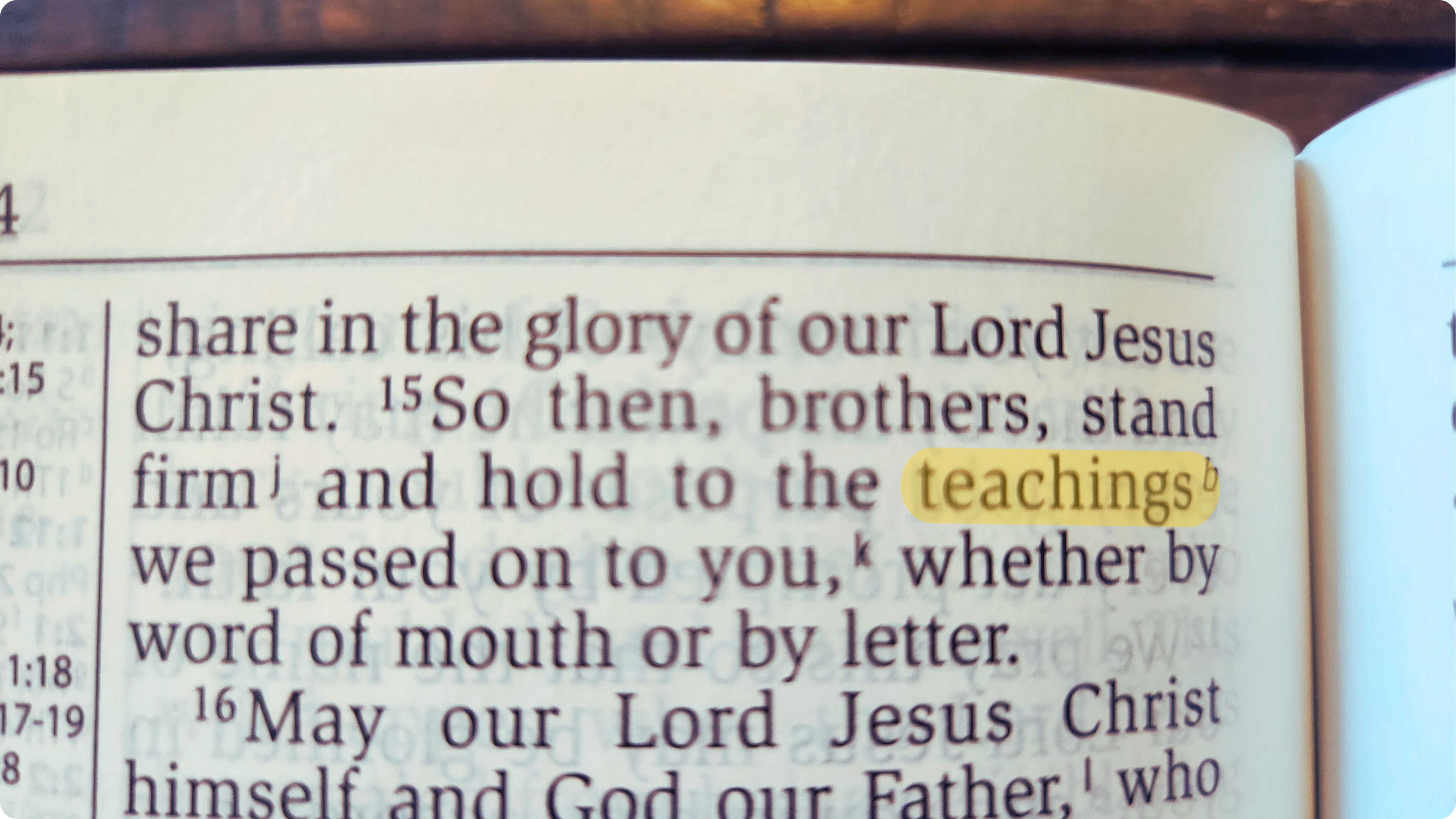
Then I noticed something else.
Paul says believers should hold to the traditions they received “either by our spoken word or by our letter.”
He doesn’t speak as though written teaching has replaced spoken teaching. Instead, he describes one body of apostolic teaching being handed on in two different ways.
Some of it was written. Some of it was spoken. Both, he says, are traditions the Church should stand firm in and hold to.
That surprised me.
For years I had assumed Scripture and tradition were opposites, as though one was good and the other was bad. But Paul doesn’t use the word that way.
In fact, he praises the Corinthians for preserving the traditions he had handed on to them:
“Now I commend you because you remember me in everything and maintain the traditions even as I delivered them to you.” 1 Corinthians 11:2 (ESV)
Circling back to the question that started this all, “Why is there an importance on Tradition when we already have God’s Word in Scripture?”
I realize now that this wasn’t about choosing between Scripture and Tradition. It was about discovering that the New Testament never asks us to make that choice in the first place.
Instead, it presents Scripture and apostolic Tradition as two ways the same faith was faithfully handed on.
And somehow, that made the Bible feel even more alive than it had before.
“What you have learned and received and heard and seen in me—practice these things, and the God of peace will be with you.” Philippians 4:9 (ESV)